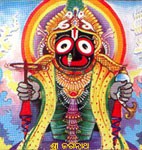
Jagannath Darshan
Shri Shri Jagannath Mahaprabhu lord of the Universe is the supreme solace and saviour of countless devotees around the world. since time immemorial, His monumental and magnificent Shrine at Shri Purusottam-Kshetra (Puri, Orissa) one of the four major Dhamas of India has been a most sacred centre of pilgrimage and worship symbolising and uploading one of the greatest spiritual and cultural heritages of the world. The most frrequently depicted theme involves the holy Triad of the Jagannath Temple - Lord Jagannath, Balabhadra and Subhadra
History of Deities
The deities of the Puri temple are generally known as the Trimurti (trinity) and also as Chaturdhamurti. Some scholars think that originally there was only image of Jagannatha as the object of worship called Nila Madhava and when Nila Madhava disappeared, king Indradyumna fabricated the body of Jagannatha out of a log of wood that was picked up from the sea, as per a divine direction. Scholars suggesting that originally there ,were only two deities, cite the example of a temple found in the Cuttack district in Orissa belonging perhaps to the seventh century A.D., where the images only of Jagannatha and Balabhadra have been carved and Subhadra is not to be seen there.
It is, therefore, believed that when there was a great resurgence of Saktism from the 7th century onwards, there was a successful attempt to instal an image of the mother goddess (Durga or Sakti) in the Puri temple by the side of Jagannatha. According to some others, installation of the image of Durga or Sakti, who is also known as Bhadra, Mangala etc., might have taken place during the visit of Sankaracarya to Puri. In the Konarka temple built in the 13th century A.D. about a century later than the Puri temple, there is a panel of three images. Jagannatha is seen in the middle and to his left is Durga killing demon Mahisa, while to his rjght is A linga (phallus) representing Siva. From this, it is deduced by some scholars that this might have been the original trio of the Puri temple, indicating the equal importance to Vaisnavism, Saktism and Saivism. In such a case, it is deduced that originally there was one image representing Visnu or Madhava and Siva and Durga were added subsequently.
There is another theory that Bhadra or Mangala (Durga) came to be called Subhadra and at the time of Vaisnavite preponderance, she was introduced as Krisna's sister, whose name is also Subhadra. Similarly one of the names of Siva is Virabhadra. Somehow, at a time of Vaisnavic effloroscence, he was transformed into Balabhadra. The second half Of this name i.e., 'Bhadra' was retained and the first half was substituted by Bala.When he was thus called Balabhadra, he was introduced as the elder brother of Krisna.
The Puranic texts mention that the original images of Puri consisted of Laksmi and Visnu known as Purusottama. a twin figure. Some literary works, bear testimony to this view too.
Vesha of Deities
The deities showing their close affinity with the human world does changes their dresses/costumes with change in time.The dresses,make up or the costume locally called as veshas starts changing with the first daily ritual of Mangala Aarati.The deities on the Ratnavedi are adorned with various gold ornament studded with precious gemes.Tulasi leaves, sandalwood paste,camphor & occasionally musk are used in the daily puja of the lords.Besides changing the dresses daily there are certain veshas which the deities use on some special occasions falling in different part of the year.
Abakasha Vesha or Tadapa Uttari Vesha
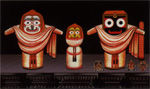
This is done daily, after mangala arati, for the abakash rituals. Abakash is the tooth brushing and bathing ritual. The clothes that are worn by the deities are called 'Tadapa' and 'Uttariya.'
Badasrunghara Vesha
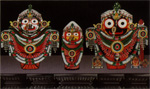
This is a very beautiful vesha. It is done before the night time 'pahuda', when the deities are allowed to take rest. It is therefore the vesha the deities appear in the following morning, for mangala arati. This vesha is mostly made of different kinds of flowers. The Lords are decorated with flowered ornaments known locally in Puri as adhara, jhumpa, gava, chandrika, tilak, alaka, guna, hruda pallava, karapallava and tadaki among others. The Deities also wear many flower garlands, some with tulasi leaves, and silk clothes called khandua.
Chandana Vesha
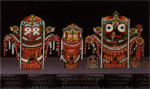
This vesha is done for 42 days, beginning on Akshaya Trutiya.
Hati Vesha
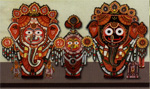
On the full moon day of the month of Jyestha, after the bathing ceremony is over, the Deities are dressed in elephant costumes. Lord Jagannath and Lord Balabhadra are made to look like Ganapati (Ganesh, the eldest son of Shiva and Parvati).
Suna Vesha
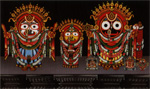
On the 11th day of the bright fortnight in the month of Ashada, when the Deities return from the Gundicha Mandir on their chariots, they appear in the Suna (Gold) Vesha. They are are decorated with golden ornaments and wear gold crowns. Lord Jagannath and Lord Balabhada appear with hands and feet made of gold. Lord Jagannath holds a golden chakra in His right hand and a silver conch shell in His left. Lord Balabhadra holds a golden club in His right hand and a golden plough in His left.
Raja Vesha
On the 10th day of the bright fortnight of Aswina,the full moon of Pousa and the full moon of Phalguna.
Banabhoji Vesha
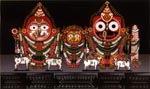
On the 10th day of the dark fortnight in the month of Bhadra, the Deities are dressed for a picnic, like the cowherd boys.
Kaliyadalana Vesha
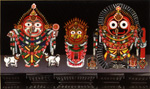
On the 1th day of the dark fortnight of Bhadra, Lord Jagannath is dressed as Krishna in His pastime of killing the serpent Kaliya(Black Cobra).
Pralambasura Badha Vesha
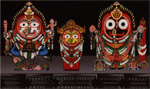
On the following day, the 12th day of the dark fortnight of Bhadra, the Deities are dressed to commemorate Lord Balabhadra's pastime of killing the demon Prahlamba.
Krishna-Balarama Vesha
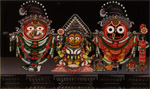
On the 13th day of the dark fortnight of Bhadra, Lord Jagannath and Lord Balabhadra are dressed very attractively as Lord Krishna and Lord Balarama.
Bali Vamana Vesha
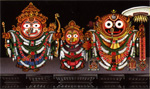
On the 12th day of the bright fortnight Bhadra, Lord Jagannath is dressed like the dwarf brahmin Vamana, who defeated the demon Bali. Vamanadeva was one of the das avatars, the ten incarnations of Lord Vishnu.
Radha-Damodara Vesha
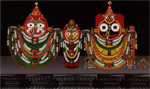
For an entire lunar month, from the 11th day of the bright fortnight of Ashwina to the 10th day of the bright fortnight of Kartika, the Deities are dressed in this vesha. Damodara refers to the lord with a rope tied around His waist, which relates to Krishna's pastimes with Mother Yashoda.
Thiakia Vesha or Laxmi-Narayana Vesha
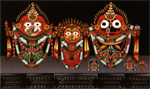
This vesha is used on the 11th day of the bright fortnight of Kartika.
Bankachuda Vesha
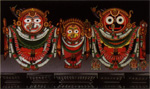
(Assuming the curted hair make-up)Used on the 12th day of the bright fortnight of Kartika.
Adakia Vesha or Trivikrama Vesha
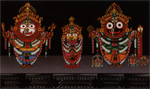
Used on the 13th day of the bright
fortnight of Kartika.
Dalikia Vesha or Laxmi Nrisimha Vesha
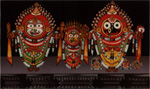
Used on the 14th day of the bright fortnight of Kartika.
Raja Rajeswari Vesha
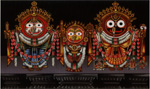
The full moon of Kartika.
Chacheri Vesha
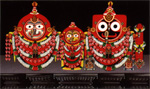
From the 9th day of the bright fortnight to the full moon of Jyestha except the 14th day.
Nagarjuna Vesha
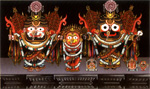
This vesha honors Parasurama, the warrior incarnation. It is used only occasionally. It happens during the month of Kartika, when there are six days of Panchaka. This was done six times in the last 30 years on 11/3/95, 11/16/94, 11/26/93, 11/3/68, 11/16/67 and 11/26/66.
Ghodalagi Vesha
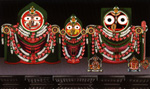
During the period from the 6th day of the bright fortnight of Margasira(Odhan Sasthi) to the 5th day of the bright fortnight of Magha (Basanta Panchami) the Deities wear winter clothes.
Jamalagi Vesha
From Basanta Panchami to Dola Purnima the Deities wear modified ghoda (winter clothes).
Padma Vesha

It is done on Saturdays or Wednesdays between the new moon day of Magha and Basanta Panchami. 'Padma' means 'lotus,' and the Deities' dresses are made from lotus, sola lace and paper. These dresses are traditionally supplied by the Badachhata Matha. Halva is offered to the Deities when They are in this vesha.
Gaja Uddharana Vesha
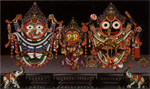
This vesha is done on the full moon day of the month of Magha. It commemorates the story of Gajendra, the king of the elephants, and the alligator.
